Sunday, 26 May 2013

Andy vs Doctor Who Part II: The Name of the Doctor

Spoilers abound!

I have been without internet for several weeks as I recently moved house, so I've only just caught up with the  last episode of this season of Doctor Who, The Name of the Doctor. After my last rant blog about the show, I thought I'd better write something about it as a finale and an explanation for the 'Impossible Girl' (grr). 

First off, in my opinion, Doctor Who is not a program that relies too much on continuity, especially in it's original incarnation. The origin of the Daleks has changed at least a couple of times (for instance between The Daleks where they first appeared and Genesis of the Daleks 12 years later), Davros, The Master, the entire Dalek race and even obscure villains like Omega have been bought back from being seemingly dead with not a lot of explanation. But it does have small nods towards it: each of the anniversary specials nod back to the previous incarnations (as the 50th will) and the Time War seems to act primarily as a way to explain differences between the old series and the new - which is fine. A program about time travel shouldn't get too hung up on it.

This episode opens with Clara giving a voice-over as she apparently falls through a time vortex. I didn't like the voice-over thing with Rose in Army of Ghosts and I don't like it here. It's padding and a very artificial way to create tension. We then seemed to see it at least five more times

But on to the main body of the episode. Essentially, Strax, Vastra and Jenny get themselves kidnapped and are whisked off to Trenzalore - a planet that The Doctor must never go to, for it is where he is buried. I would have thought that crossing timelines with yourself when you are still alive would be a MUCH bigger problem, but whatever, I'm not a time traveler. Eventually they make their way to the center of the dying TARDIS, where The Great Intelligence (Richard E Grant) steps into the center of one of the coolest things I've ever seen on Doctor Who (quite literally, his life-line) and corrupts the Doctor's entire timeline. At which point, Clara steps in as well and fixes everything, explaining how she got scattered across time and space. 

Right. 

From other reviews I am reading about this, this was seen as one of the greatest series endings of all time. I am not convinced. I had all sorts of problems with this episode. Here are some of the biggest:
  1. The Doctor's timeline is just sitting there, on Trenzalore. Yes, the actual name of the Doctor is required to get to it, but one door blocks the way to something that could potentially destroy entire civilizations in seconds. You don't even have to be planning to do it. Trip up the steps and rework history. "Whoops-" FWOOOM.
  2. Wasn't it the Silence's job to stop them getting to Trenzalore? Where the hell were they? I didn't particularly like them either, but you can't rewrite continuity and ignore it at the same time.
  3. Clara has been about for all of the Doctor's incarnations, and the 11th is the first to notice her. Seriously?
  4. Even if she was scattered through time and space, presumably she was still human. Why the hell was she on Gallifrey?
There are others (why were Strax and Vastra still on Trenzalore at all, let alone fighting?) and Stephen Moffat nicely undermined the poignant ending to Forest of the Dead by having a post-that River come back. In that episode, she died to save a man who didn't know who she was yet. It was perfect. Leave it alone. This was a tear-jerker, but a hell of a cheap one. Also, has she been holographically hanging around in the TARDIS since then? This certainly implies it. "I can always see you..." indeed. 

Forest of the Dead, more poignant the more you got to know River
(It's worth pointing out with regards to River, for one glorious second I thought she'd been prompting Clara all the time she was in the TARDIS. That would have been a nice twist as well as extremely funny.)

But the ending. Oh my lord. All of my objections and questions and problems were blown away by that one reveal. Forget Clara, John Hurt is a hell of a mystery. My personal theory is that I think he might be the meta-crisis Doctor from Journey's End, but anyone else got a good one?

Tuesday, 21 May 2013

Lord Tebbitt commits some Logical Fallacies

In a bid to make myself feel like a good samaritan I bought a copy of The Big Issue today. In it, Lord Tebbitt, who is, shall we say, slightly opposed to the idea of gay marriage, makes several charming statements:
“When we have a queen who is a lesbian and she marries another lady and then decides she would like to have a child and someone donates sperm and she gives birth to a child, is that child heir to the throne?’
“It’s like one of my colleagues said: we've got to make these same sex marriages available to all.
“It would lift my worries about inheritance tax because maybe I’d be allowed to marry my son. Why not? Why shouldn't a mother marry her daughter? Why shouldn't two elderly sisters living together marry each other?”

What a nice man. I write about this today though, not to make any comment on the issue itself (I know people who have strong opinions in either direction) but because it provides an excellent platform for discussing something I find interesting - logical fallacies.

First off, the obvious - The 1949 Marriage act has a completely different set of rules for marrying relatives; they're listed out in the Table of Kindred and Affinity, which quite sensibly states that not only can you not marry your son, you also can't marry his wife if he is still alive. Also there are seperate incest laws, not to mention the possibility of getting accused of tax evasion, although ultimately I discount the idea that Lord Tebbitt genuinely wants to marry his son and is instead not being serious. This is our first fallacy, and it's called the Appeal to Ridicule - presenting an opponents arguments in a way that makes them seem absurd. 

If I was being cheeky, I could also call the middle sentence an Appeal to Anonymous Authority - if this colleague said it, why must it be true?

But the first paragraph is truly a gold mine. Here, he posits a series of occurrences, which leaving our fallacies for a minute deserves a closer look. The question posed at the end relies on a number of things happening, but let's for a minute assume that he could be talking about the Duke and Duchess of Cambridge's baby. Below, I list the assumptions his question has to make, followed by my best statistical estimation of them actually occurring.


  • The baby is a girl
    • 50%, give or take. The couple may be genetically predisposed one way or the other (but we don't know), and there is a slight difference in the rate of boys to girls at the moment, but not enough to shift the percentage.
  • The girl is gay or bisexual
    • Bit trickier, this one, but the UK census suggests a rate of 1.1 % for the former and 0.4 % for the latter. This obviously only includes those who self-identify as gay, but I realized this isn't a problem because Lord Tebbitt assumes/implies that this Queen must have self-identified at some point.
  • The girl is married
    • This is where it gets tricky. Assuming that all those in a civil partnership would get married if the opportunity arose (a statistical leap in itself) and that the rate stays the same (again, bit of a stretch) there would be around 53,000 same sex marriages in the UK at this mythical point in the future. Assuming it takes two to tango, that puts the number of people (in total) in same-sex marriages at around 0.16 % and (assuming straight people aren't in same-sex marriages) the number of gay people at around 14.5 %.
  •  The girl wishes to have children via artificial insemination
    • This is apparently about 41%, according to one survey. I am not going to cite all of my references, as these are all approximate.
  • It is successful
    • This is tricky to estimate, but assuming she's under 35, the success rate is about 32.5 %, according to the NHS, and the percentage declines after that point.

How likely is Lord Tebbitt's hypothesis? By multiplying all of these together, the odds come out somewhere around 0.1 %. I think the primogeniture question of the throne is pretty safe.

So which fallacy is this he's using? This is called using Misleading Vividness. He has described a  scenario in such detail that you see the problem before considering how likely it all is. Interesting stuff.

And if you think, even after all this, that this particular argument is one that still needs to be thought about, I direct you to your own personal fallacy: the Appeal to Probability. Just because something can happen, doesn't mean it will, even if it is likely. This is very, very unlikely.

The conclusion we can all draw from this is that this doesn't exactly add anything to the debate about gay marriage on either side, just that we can safely ignore Lord Tebbitt and instead look at this cool diagram of logical fallacies.

Monday, 20 May 2013

The Frankenstein Theory - Movie Review


As someone who takes an almost perverse pride in plumbing the depths of horror-related obscurity I am ashamed to admit that this one flew completely under my radar. But someone lent it to me on Friday and I thought it was awesome. You should go and watch it.


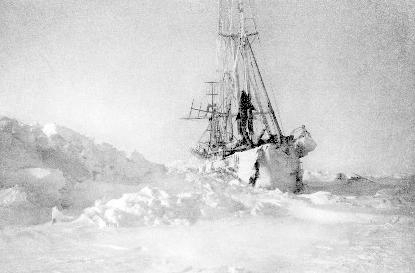
First, a little background (I would say spoilers, but the book was published in 1817). The novel, Frankenstein is about a young medical student creating a new man (the method is never made clear) and then abandoning said man when it is monstrously ugly. Apart from these physical, er, limitations, the creature is an intelligent, reasonable being who ends up with severe parental abandonment issues, goes on a roaring rampage of revenge and the book ends with a half-mad-with-grief Victor Frankenstein pursuing his creation to the Arctic in order to finally kill it. The framing device is the letters of the captain of an arctic exploration vessel that finds Victor mid hunt and doesn't exactly believe him until he sees the monster himself. Victor dies, his quest unfulfilled. The monster grieves over his 'father's' body, saying:
I shall die. I shall no longer feel the agonies which now consume me or be the prey of feelings unsatisfied, yet unquenched. He is dead who called me into being; and when I shall be no more, the very remembrance of us both will speedily vanish. I shall no longer see the sun or stars or feel the winds play on my cheeks.
This is where this is happening. It's pretty grim.

It's one of my favourite books, and possibly the greatest gothic "places where science dares not tread" book ever written. Certainly the most famous. So why do I re-hash all of this? Because The Frankenstein Theory, set in the modern day, posits the idea that Frankenstein was a work of non-fiction disguised as fiction and that somewhere in the arctic wilderness, the monster lives.

Yeah, yeah, I know, the premise is faintly ridiculous, but the film follows through with it to such a degree and treats it with such seriousness that by the time the documentary crew reaches the icy wastes of North Canada you're pretty much sold. The method by which the location of the monster is estimated (a combination of migratory patterns and unexplained murder reports) is a work of creative genius. 


This is a 'found-footage' film a-la Cloverfield and normally I don't get on with them (they make me feel ill) but this is probably the best I've seen. There's really only five characters, Professor Venkenheim, the man who believes his Great-great etc. Grandfather conducted the original experiment, Vicky, the director/presenter of the documentary they're filming about the hunt, the camera guy and sound guy, and Carl, the Canadian guide who is probably the most memorable. Venkenheim is the most interesting, however, in a role mirroring that of Victor's in the novel - obsessional to the point of endangering those around him. This is evident in an early scene when he pushes a potential eye-witness too far and has terrible consequences later on. The rest are a likable bunch, but meat on the hoof to a man (or woman). The 'found-footage' concept alone doesn't exactly bode well for a happy ending. 

Carl also endears me by riffing on that famous scene in Jaws where Quint tells the story of the Indianopolis except with a polar bear rather than sharks. It's pretty creepy.

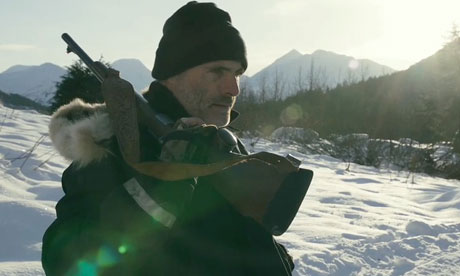
Carl, single-handedly making the Northwest territories cool
It's also very pretty to look at. The wilderness as presented is a harsh yet beautiful place, a place that could easily kill you even without anything else. There's a fun theme throughout of the encroachment - and de-civilizing effect - of the wilderness, with a hunter's yurt literally and symbolically becoming an increasingly flimsy refuge. 

Any faults? Other reviews have called it slow, and it's true that it takes a long while to get where it's going, but for me that allowed me more time to buy into the concept. It also ends rather...suddenly. But still a heavy recommendation from me.

One more question I bet you're asking. Do they find what they're looking for? Well, that would be telling, but let's just say that the theme of de-civilization is taken to it's logical extreme. 

GO WATCH IT. 
 

Tuesday, 14 May 2013

Andy vs Doctor Who

Next week I plan to do a serial story over the five days - Part I on Monday, Part II on Tuesday etc. This week however, I am taking time off to write about one of my favourite things - Doctor Who, partly because I want to write about something people have actually watched for once and also because it...troubles me at the moment.

Before you read any further, this is a rant blog for people who are up to date with the show – I’ll try to keep spoilers to a minimum, but if you’re somewhere behind The Bells of Saint John this may not be of interest to you and I will obviously be talking about some of the stuff that happens in the subsequent episodes.


I don’t really care what Clara Oswin Oswald is. And I am beginning to suspect I am not alone. 

Screenrant has an excellent guide to people who are new to Doctor Who. It ignores the pre-2005 series, rightly guessing that it is daunting and overwhelming for new viewers to dive into, at least initially (although it does offer a couple of suggestions),  and instead highlights a few of the new episodes that are a good starting point.

This can be a tad contentious (fans are defensive of their favourite episodes – I know I am - and I have yet to meet a fan who isn't)  but one of the best parts in my opinion is a list of ‘tips’ for watching Doctor Who. The last reads “…be aware that you will not likely be happy with each new companion at first.” Excellent advice.

One of the things it doesn't cover for new viewers however is the prevalence in Nu-Who for season-wide plots to be subtly hinted at, through the use of arc-words (Bad Wolf, Silence Will Fall) or names (Mr. Saxon, Torchwood).  Generally these tend to be in the background, and get resolved in the season finale. But if you’re a fan, of course you already know that. In my opinion, they work best as borderline Easter Eggs, and the less they infringe on the week-to-week stories, the better.

The best example of this, I think, was the mysterious Mr Saxon. He was never shown until the end, always name-dropped by someone back on Earth as a shady ‘benefactor’, subtly manipulating behind the scenes. His eventual reveal was doubly good, because it lived up to its hinted promise as well as highlighting the fact that the Doctor really should have been paying more attention.

Which brings us to Clara.

Clara is annoying. Some people may find her less so, but I have yet to speak to one. She’s smart-alecky and overly talkative in that irritating rapid-fire way writers confuse with genuine wit. She worked well in her first appearance in Asylum Of The Daleks. The reveal that her chirpy personality and endless soufflĂ© making were essentially denial and that she had been turned into a Dalek in the middle of a facility full of the craziest, most dangerous Daleks was a hell of a good twist. It was dark, it was tragic. It was awesome.

But then she came back, and the show writers made the fatal error of combining the new companion with the season’s major arc. Remember the rule up there? In other seasons if I took a dislike to a companion I could still get interested in the broader story as well as the week-to-week. I didn't like Amy Pond at first, but the stuff about the Silence and the Cracks didn't depend on her in the slightest. This way, however, the show runners have put all their eggs in one basket and disliking Clara makes the arcing plot (her being ‘impossible’ which in this case means ‘functionally immortal’) utterly dis-interesting   The best episodes from this season so far have been the ones that didn't draw attention to it at all, namely Cold War and The Crimson Horror the latter noticeable for providing far more interesting companions in Strax, Lady Vastra and Jenny.  Hide unfortunately showed a slightly old fashioned ‘doctor-companion’ relationship between Professor Alec Palmer and Emma Grayling that seemed infinitely calmer and preferable.

So why am I writing this now? Well, apart from the monolithic Blink, I hadn't re-watched any of the previous episodes of Doctor Who since they were on, but this Sunday I ended up watching The Lazarus Experiment, The Shakespeare Code and Human Nature/The Family of Blood, all from Series 3. Many people would argue this doesn't represent the strongest selection from that series (again though, arguments may/will ensue) but I was struck by three things:

1)      The quality of the stories was pretty good, with a solid structure and even some vague attempts at social commentary.

2)      The Saxon arc was extremely unobtrusive, only being very briefly mentioned in The Lazarus Experiment.

3)      Martha actually did stuff. She was practical, brave, loyal and most importantly relatable. Quick-paced dialogue is not a substitute for convincing characterisation.

I realised I had been in denial. The show has slipped in quality, and now has some serious problems. I am not going to abandon Doctor Who any time soon and it still retains a huge chunk of my affections, but these are my suggestions to the show runners that I think would improve it:


·         Realize that the core ‘mysteries’ of the series are best kept in the background until the end. Over-exposing them quickly makes them boring, confusing or both.
·         Realize that even if this were the case, the core mystery for this series is not very interesting. We need to get to know Clara before we care what happens or is happening to her. Amy Pond skated dangerously close to this with the cracks in time.
·         At the moment you have a ‘mystery’ immortal girl and a mad-man-in-a-box Time Lord adventuring through time and space. The companion is in many ways supposed to be a stand-in for the audience. Who are people supposed to be relating to at the moment, the TARDIS? (Addendum: This does not necessarily mean that the companion has to be human. They just have to react to their surroundings like a human – be it confusion, wonder or terror. Come on guys, it’s not hard. Like I said, I think Strax, Lady Vastra and Jenny would be awesome companions)
·         Please, please, please go back to finishing off plot-lines convincingly. Are the Silence coming back or aren’t they? To be fair though, Amy and Rory’s exit was exactly what it should have been - sad, true to the characters and FINAL.

Also, these three in a spin-off show would be awesome.

And seriously, no-one cares about Clara.

Anyway, that’s enough for now. What do you guys think?


Friday, 26 April 2013

Whatever Happened to Baby Jane... and Andy's blog, for that matter


After a long couple of weeks in which I either seemed to be applying for jobs or watching Game of Thrones/Survivor in the last few days I've finally got on back on the Old Horror Movies wagon (or fallen off of the 'I really should stop watching Old Horror Movies' wagon. Either/or).

So what I have been watching this week? The three big ones have been Dementia-13, Francis Ford Coppola's first film that doesn't exactly hint at his future greatness, The Terror, which featured Boris Karloff and apart from that was genuinely terrible (girlfriend's take on the other end of that link) and Whatever Happened to Baby Jane? which was far, far better than either of these, so that's the one I'm going to write about - mainly because I would rather encourage people to watch something good than to avoid something they wouldn't come across anyway.

Jumping straight in. The film opens in 1917, with the vaudeville performance of one Baby Jane Hudson. The act is almost unbearably twee by modern standards ("I've written a letter to Daaaddy, his address is Heaven above...") and I can't really see it being this well loved in 1917, but whatever, I'll buy it. The kid comes off stage and unsurprisingly is an utter brat to all her family, including her older sister, Blanche.

Skip forward to 1935, with two producers talking about Blanche and Jane, the former an extremely bankable movie star with a bright future ahead, and the latter a terrible actress with a drinking problem, only getting jobs as part of her sister's contract (hilariously, they use one of Bette Davis' actual movies from the 30s to 'illustrate' this). But this arrangement comes to an end, with a car 'accident' leaving Blanche confined to a wheelchair.

Skip forward again to what the title card refers to as 'Yesterday'. The sisters, their respective stars long since faded (although it's shown that Blanche Hudson's films are remembered fondly, and nobody really remembers Jane) now live in a house together with Jane looking after Blanche (Joan Crawford).  Blanche is virtually confined to her room - there's a certain cruelty implied in it being upstairs - and a lifetime of suppressed jealousy, narcissism and booze has reduced Jane (Bette Davis) to a barely functioning level. She's circling the drain, so to speak. One more swirl and her mind will go completely down the plug hole.

Probably not the best time to discover your passive-aggressive well-meaning sister plans to sell the house and have you committed then. With Jane nuts, and Blanche terrifyingly vulnerable thanks to her chair, the rest of the movie pretty much plays itself out exactly as you would expect.

The surprising thing is, however, that there is very little schadenfreude in Blanche's predicament. Part of this is due to Joan Crawford's sympathetic portrayal, and part of it is due to what is done to her. It's unpleasant, but it's also unpredictable. This is not torture porn, nor is it a campaign of psychological torture, it is simply Jane doing things in the moment, in response to 'slights' shot through the prism of her madness and jealousy which is somehow more disturbing. When the abuse moves from the passive and largely psychological to the physical, it is in response to events as opposed to a natural progression.

For this reason, Jane comes across as one of the best villains I have seen on film for a long time. She's batshit insane, malicious, petty, frequently drunk, duplicitous, delusional and looks like she could use a good shower. It's implied that she simply re-applies her make-up every morning and almost certainly smells foul. She tramps around the house with little of her former grace and speaks with a voice that sounds like a key scraping up and down a harp. She is, in short, a monster, albeit not an entirely unsympathetic one. She never got past the age of 10.


A lot was made at the time about this being a collaboration between Joan Crawford and Bette Davis (who reportedly hated each other - this was the only time they worked together) but this is Bette's film, through and through. There are other subplots, including one involving a pianist who's suspiciously close to his mother and who I assumed was some sort of con-man, and another involving a neighbour trying to be friendly and her daughter who appears once for exposition and then vanishes. Meh, you can ignore them. The core conflict is what drives this film. It's awesome.

Any problems? There is probably one too many 'Blanche tries to do something in a race against time before Jane gets back' scene, the subplots don't exactly integrate  and occasionally the soundtrack grates rather than compliments. Characters do do some stupid things as well (why the hell did the housekeeper put down that hammer?) but most of those can be hand-waved by them underestimating the level of Jane's insanity. 

A certified horror classic, and one that I am proud to now have in my collection. I dare you not to feel a shiver up your spine as Jane reprises her act as an old woman. I've written a letter to Daaaddy...

----------


(Blogger's note: This film spawned a new subset of horror known as the 'psycho-biddy' film, many of which also starred Bette Davis. The best two were undoubtedly Hush...Hush, Sweet Charlotte which was also really good and I will review at some point and The Nanny, which I reviewed as part of my Hammer Horror series. If you wanted to do a triple bill of linked horror films, you could do a lot worse than these three.)  

Tuesday, 2 April 2013

Prometheus Redux


...or flogging a dead horse.

(Warning - I assume people reading this have seen the film. Not massively spoiler-y, but I do talk about ideas in the film that wouldn't be familiar to a non-viewer)


It takes a lot to make me change my mind about something, especially a film. If my endless posts about 60s Hammer films are anything to go by, I am extremely forgiving but when I don't take to something, I really don't. If I have to watch Mulholland Drive again, there had better be a stone cold cash incentive.

Which brings me back to Prometheus. I've written a bit about Prometheus before, to highlight the use of 'good' and 'bad' ambiguity (quick recap for those who don't want to read that link, 'good' ambiguity is when something is left to your imagination, but doesn't detract from the overall plot or atmosphere and 'bad' ambiguity is when you rely on the audience to fill in plot holes with their own speculations).

The way I viewed Prometheus was that it could have, should have, but didn't quite. It was probably my biggest disappointment for 2012, although it was competing with The Avengers, Dark Knight Rises and Pirates! so the bar was set pretty high. It was also compared frequently and favourably to Alien which is a terrible idea around me because it does set my expectations a bit higher than usual (understatement).

So now nearly a year on, I returned to it, having forgotten some of it, remembered other bits, with a vague sense of unease and a fresh pair of eyes at my side(1). And here's the twist. I liked it a lot more this time around. Now, if pushed, I would put it somewhere around the middle of the pack - beneath both Alien and Aliens, about on a level with Alien Resurrection, better than Alien 3 and a LOT better than AvP and AvP: Requiem.

So what changed my mind?


Basically, I approached Noomi Rapace's character in a completely different way. In my first viewing, she came across as almost the sympathetic protagonist. This is a mistake. She, along with Mr. Weyland, are zealots. Fools chasing a dream of religious enlightenment and immortality, respectively. The way the Engineer reacted annoyed me the first time. This time, however, he came across as a creature awakened by pests. His reaction is foreshadowed in an exchange earlier in the film with David the android:

Charlie Holloway: We made you cause we could.
David: Can you imagine how disappointing it would be for you to hear the same thing from your creator?


For all of the metaphysical stuff thrown about in the film (one of Weyland's questions is about what happens when we die - a ludicrously optimistic question) we are eventually shown to be a science experiment - one that has either run its course, or has been deemed a failure. A bit of a blow to the ego, really, after centuries of theological and philosophical speculation.

Seen in this light, the Engineer at the beginning of the film suddenly becomes not a heroic figure, but rather a scientist sacrificing himself for an experiment. Ultimately this is a very nihilistic view of humanity. There is no God, no greater purpose. We exist because others could create us for the sake of creating us. They think they owe us nothing as their creations

I criticized the film for having ideas that go nowhere. On closer examination, they do, they go Nowhere. The result is rather Lovecraftian - we are at the mercy of forces that are utterly beyond our comprehension and technological reach. We are alone in an uncaring void. 

It is a strangely touching moment, then, when two minor characters vow to continue their bet on the Other Side before sacrificing themselves, the movie having spent the majority of its length viciously deconstructing that very idea.

Having said that though, some of the acting is still dodgy. There are still far too many characters, and the ending still makes no sense (let's go find the people who clearly want to kill us!) BUT I like it a lot more now than I did.

Mark this day for I am a stubborn bastard. (2)

-----------

(1) I didn't really go too much into David's character in this because Lilly has done a pretty good job of describing my impressions of him. One thing to add, however, is that he reminds me a hell of a lot of HAL 9000 (I'm afraid a can't do that, Dave), progressing through deception up to curiosity and murder. The difference is that David reaches the end of his emotional journey, whereas HAL gets unceremoniously unplugged.

(2) Alien is still better though...

Friday, 15 March 2013

The Hills Have Eyes - Movie Review

As pretty much anyone who has met me or even glanced at this blog, will know, I like me some obscure Horror Films. Case in point; I saw a Belgian Vampire film called Daughters of Darkness the other day and it was really, really good.

(A short guide to French and Belgian horror: soft lighting, dialogue, soft lighting, soft lighting, dialogue, VIOLENCE...soft lighting, ambiguity)

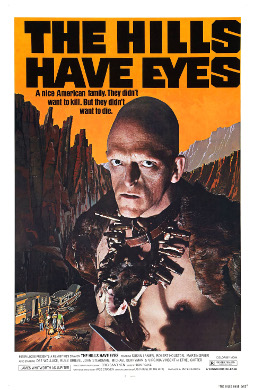
Of course, I am still a massive fan of the 'classics' - I could literally write thousands of words about Night of The Living Dead, for instance - but there was always a couple I hadn't seen. 1977's The Hills Have Eyes was one of the more prominent. Released in the prime of Horror's Last Great Age by Wes Craven (seriously, check out how many classic horrors were released between 1975 and 1982, I'll wait) it's also famous for having an awesome poster. And I finally saw it last night.

I love this, regardless of the film
And, yeah. It's a film.

A 'nice' American family are driving in their RV to California and decide to take a detour through the desert to see an inherited silver mine - despite warnings from a Redneck gas station attendant (scoring zero points for originality, despite a fun performance from John Steadman). They break down, one of the two dogs gets mysteriously killed and basically it's suburbanites vs. insanely tough cave-dwelling hillbillies. That's it. There is not a lot more to it.

The characters are all fairly flat, pretty much losing my sympathy after not listening to a man who's not handing out cryptic 'I wouldn't go that way if I were you' quotes but who bluntly tells them it's dangerous and is clearly terrified. The 'other' family are a lot more charismatic, and actually have a motive for their attacks (crazy as they are). They also lecture corpses, wear fur and bones and are all named after planets. 

It's two faults of the film that the 'good' family are both less interesting to watch and such morons that you don't really sympathize with them at all (at least I didn't) even when horrendous stuff is happening to them. This is a major problem with a lot of modern horror films in the same vein - you've got to feel bad when people die.

It has a vague thread running through it about the dehumanization of the 'good' family (or rather de-civilization) which is somewhat interesting, but it doesn't really add up to much.

So is there any reason to watch it? I suppose if you like your horror uncluttered with pretensions of social significance you may like it, but there is one redeeming feature of this film. That is the other dog, Beast (the deceased dog being called Beauty, because Wes Craven thinks subtlety and subtext can go screw themselves). For the first two thirds of the film, the only remotely competent thing done by ANYONE is done by this dog. It directly deals with threats far more efficiency than anybody else. This is a dog that Gets Shit Done.

Seriously Awesome Dog
This is a film with about a dozen named characters. The dog is the best one, by a considerable margin. I think that says enough about the film.

The Hills Have Eyes? Meh.

Beast the Wonder Dog? 5 stars!